As you’ve probably learned from our previous article (see article), NCAA and individual colleges set minimum GPA and SAT/ACT requirements that must be met in order for an athlete to be eligible for recruitment. You can find the NCAA minimum requirements here and NAIA requirements here. When an athlete falls below these minimum standards, no school can recruit the athlete no matter how talented he is. If you don’t meet the minimum academic requirements for recruitment or the requirements for your top choice, there are still a few paths to play college football.
Before Your Junior Year In High School
If you haven’t started, or have just started your junior year in high school, you still have time to turn your grades around. And just like getting to be a great athlete, getting good grades requires hard work and proper preparation. This is as important as any weight room session, practice, game, or highlight tape to accomplish your goal of being a college football player. If you treat your academics with that level of importance, you will succeed. Time management and proper studying skills are crucial, so here are some tips:
Meet with your teachers for extra help on your assignments/test prep - You will learn the relevant material best from the teacher directly, and when the teacher knows you are working hard, they will help you earn better grades.
Make sure you have a calendar that has all of your time commitments, including school and sports commitments - This way you know what free time you have so you can schedule your homework and studying.
Properly plan your week in advance - Mark down any tests, papers and projects so you know what you have to prepare for.
Do not procrastinate - Leaving your work for the last minute will inevitably lead to not enough time to complete the task well, and subsequently bad grades.
Take advantage of school resources such as study halls and tutors - These are valuable resources, especially if you are not getting proper study time at home. Study hall teachers and tutors can help you understand the curriculum so you are better prepared for your next test or project.
For more tips on time management and studying look at these 10 study tips from Youth Central (see article).
Before your Senior Year in High School
If you haven’t started your senior year yet, there is still a chance that you can turn your GPA around. You can retake some of your classes in order to improve previous grades. If you are able to retake a class, doing it in a traditional classroom setting during the year or during the summer is your best option to ensure that the class meets all of the NCAA requirements. Ideally, you want to take summer school classes at your current high school, but if this is not available to you, taking them at a different high school or district is possible, but you will have to send in a second transcript to the NCAA to prove eligibility.
If the traditional methods of repeating a class are not an option, you can look into taking online or other non-traditional classes. The NCAA has cracked down on non-traditional courses, so make sure that these courses are approved by the NCAA so you don’t waste your time and money. Additionally, each of these classes must pass a PSA Review by the NCAA, where the student and the school must show that the student did not skip any sections or rush through work, and that all of the grades and scores are legitimate. It’s important to keep detailed logs and records of your class work if you must take the non-traditional route.
However, the impact you will have on improving your GPA at this point in your high school career will most likely be small. You must focus on getting the best score on the ACT and SAT tests. The best path to success is to take both the SAT and ACT early in order to determine which test you are better at taking. Typically, stronger math students perform better on the SAT and poor math students are best at the ACT. Once you know which test is better for you, take prep classes to improve your knowledge and test taking skills, and keep taking it as many times as possible. You can focus on one section (math,verbal, etc.) each time you take the test because schools (and the NCAA) will look at all of your attempts and combine the best scores for each of the sections from all of your tests to create the highest cumulative score.
If You Are Still A Non Qualifier (or unable to qualify for your school of choice) By The End Of High School
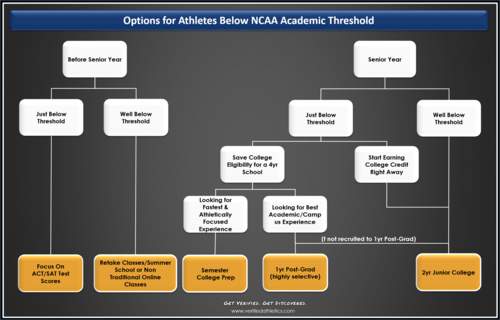
If you are finishing your senior year and are unable to meet the minimum academic requirements, there are options that can help you defer your recruitment until you improve your grades or test scores. These options are traditional full-year Post Graduate Programs (PG’s), one semester College Prep Schools, and Junior Colleges (JuCo’s/JC’s). However, each of these options can cost money or eligibility years and can be very different experiences. But regardless of your choice, you must ask yourself ‘what will you do differently once you get a second chance at improving your academics so you can get recruited by an NCAA football team?’
Post Graduate Schools
If your grades are just below the minimum threshold, Post Graduate schools (PG) can be a good option. Don’t be confused, these schools are Prep Schools but not all schools with “prep” in its name offer post graduate programs. These schools are the best option if your grades or test scores are just below minimum requirements because your transcript from your high school will carry over and you will only be able to make small changes to your overall GPA (by adding a few classes and replacing a few of your worst grades). Additionally, these programs can help improve your SAT/ACT test scores with rigorous prep classes, but you will only improve your eligibility if you improve your academic focus. Attending a PG program does not count against your college football playing eligibility, it is a 5th year of high school. There are two kinds of Post Graduate Programs:
Full Year Postgraduate Programs -
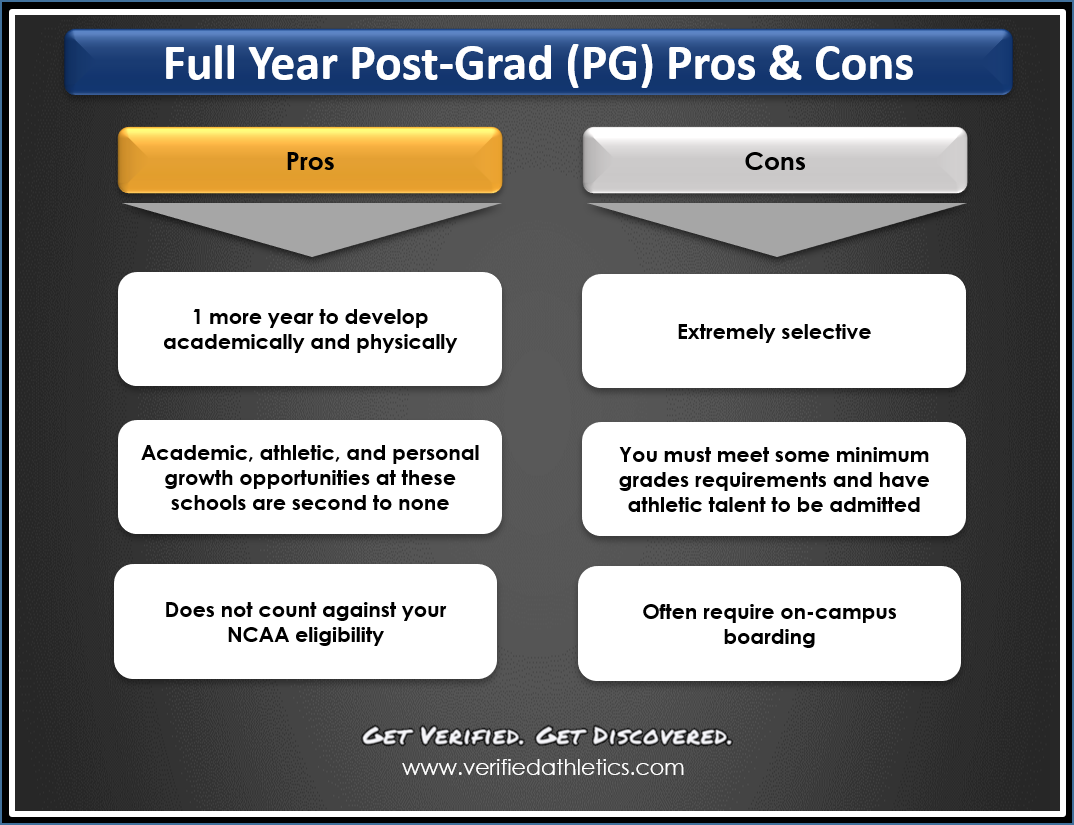
These programs are mostly located in the Northeast and are provided by preparatory, private 9th through 12th grade high schools that offer postgraduate programs for good athletes looking to improve their test scores and grades. Each student will pay a private school tuition, but they do work with students to provide need-based financial aid that can cover all or part of the cost of attendance. These schools are looking for athletes that are likely to be successful in the classroom and on the field. Therefore, you must meet some minimum grades requirements and have athletic talent to be admitted. A lot of these schools are some of the most prestigious high schools in the country. Most of the school student population is there for the full four years and come from families that can afford the high costs of these schools. The academic, athletic, and personal growth opportunities at these schools are second to none. However, most of the football programs can only take 4-8 PG students per year, so the spots are very selective and sometimes the PG students can feel out of their comfort zone and isolated in the new environment. The schools often require on-campus boarding for the full year of the program. Some example full year postgraduate schools include The Taft School, a 9-12 private preparatory boarding school in Watertown, Connecticut and Fork Union Military Academy, an all-boys 9-12 private preparatory boarding school in Fork Union, Virginia.
Semester College Prep Schools -
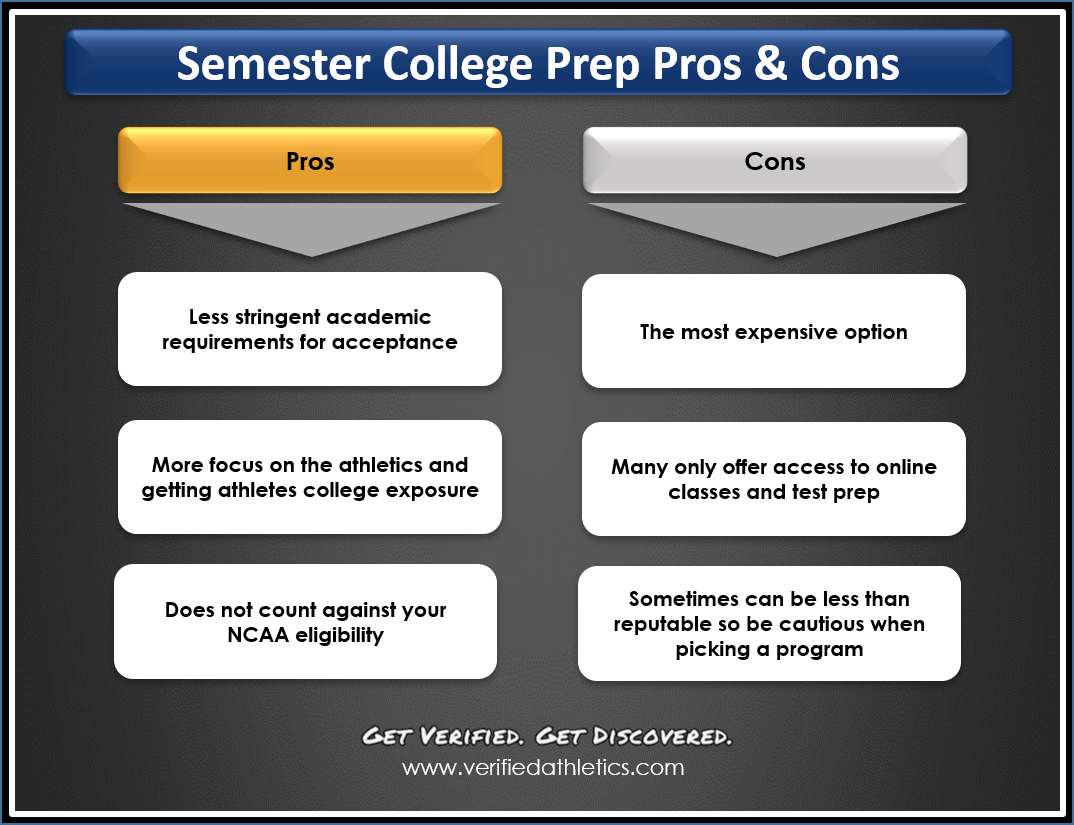
These are schools that offer one semester of postgraduate work for students looking to improve their academic standing and get to college a semester earlier. Unlike full year programs, semester programs have less stringent academic admission requirements and will usually admit anyone willing to pay the tuition. Many of these programs are essentially “football factories” designed specifically to get athletes college exposure and help athletes qualify as quickly as possible. Many of them only offer access to online classes and test prep in addition to football practice and games. While some of these programs have good reputations, parents and athletes should use caution when attending these schools (see this article).
Junior College
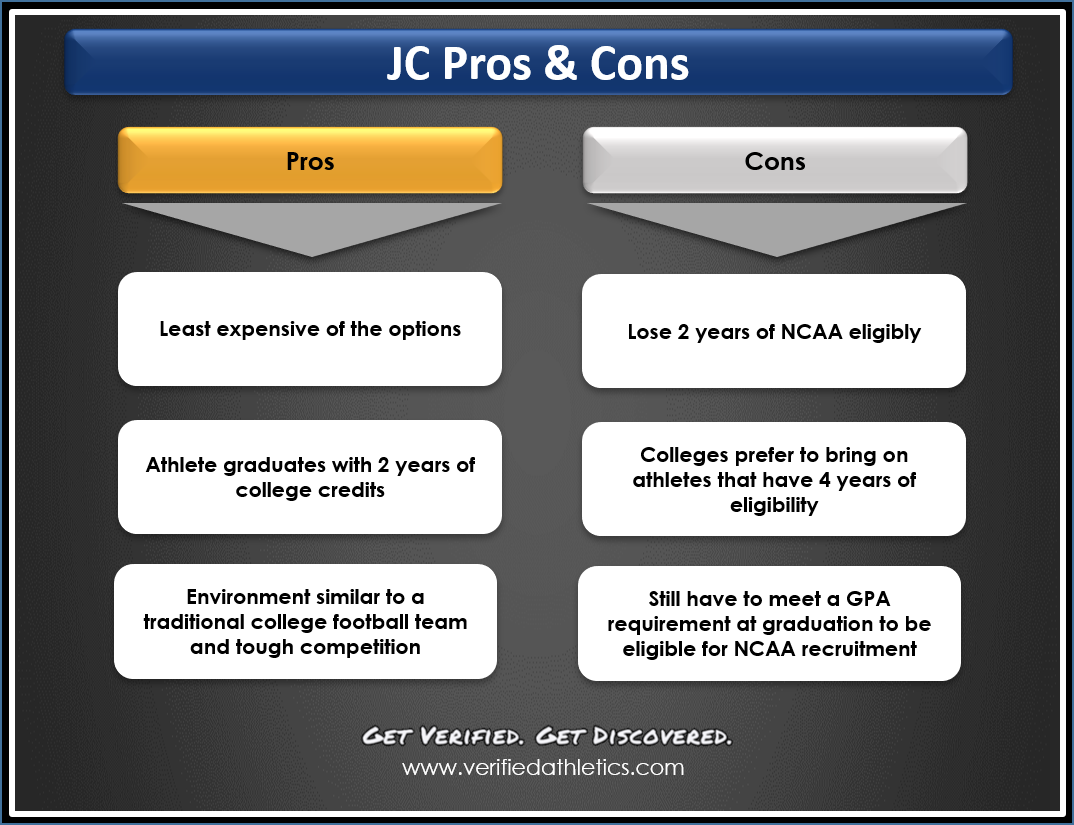
Junior college (JC) is the best option for athletes whose grades fall well below the minimum academic threshold. To be accepted into the programs, the athletes must show a high school or high school equivalent diploma. Junior colleges are 2 year programs and students receive an Associates degree upon graduation. They are likely similar to a local community college you are familiar with. After finishing a two year JC Associate degree, your high school grades will no longer matter and you can qualify under NCAA requirements if you have a 2.0 GPA and 48 transferable credits.
One of the main benefits of going to a JC is that these programs are affordable for students. They average $3,500 per year, and can be free for low income students after Pell Grants. Additionally, NJCAA, the governing body of the junior college athletics, permits its schools to provide full tuition scholarships to athletes but there are guidelines depending on the division the school is competing in.
The junior college football programs are governed by two large athletic associations, the nationwide NJCAA mentioned above and the CCCAA which is comprised of California-only junior colleges. There are 65 football programs in the NJCAA and 68 football programs in the CCCAA. Junior colleges governed by the NJCAA can be found all over the country and include schools like the reigning football champions East Mississippi Community College, as well as Garden City Community College in Kansas, Snow College in Utah and Rochester Community, and Technical College in Minnesota.
JCs offer a great way for athletes to hone their skills while improving their academics. Athletes benefit from an environment similar to a traditional college football team and tough competition. You will play against other good athletes that are looking to go to the next level. Additionally, most athletes will end up playing more football over the two JC years than they would the first two years at a 4 year school because you won’t compete against Jr’s and Sr’s for playing time. However, it’s important to note that going to a JC will count against your NCAA eligibility and therefore you can only play for another 2 years after transferring to an NCAA school. Athletes leaving a JC are both a plus and a minus for college teams during recruiting. Colleges would prefer to bring in players with all 4 years of eligibility intact, but JC grads are more college ready and can be a good answer to filling a team’s immediate need.
Takeaways
Work hard and get good grades in high school so you can directly qualify for NCAA schools
It is never too late to turn things around and there are options for all athletes
You need to prioritize your academics if you want to get to college, stay there, and graduate, so start now
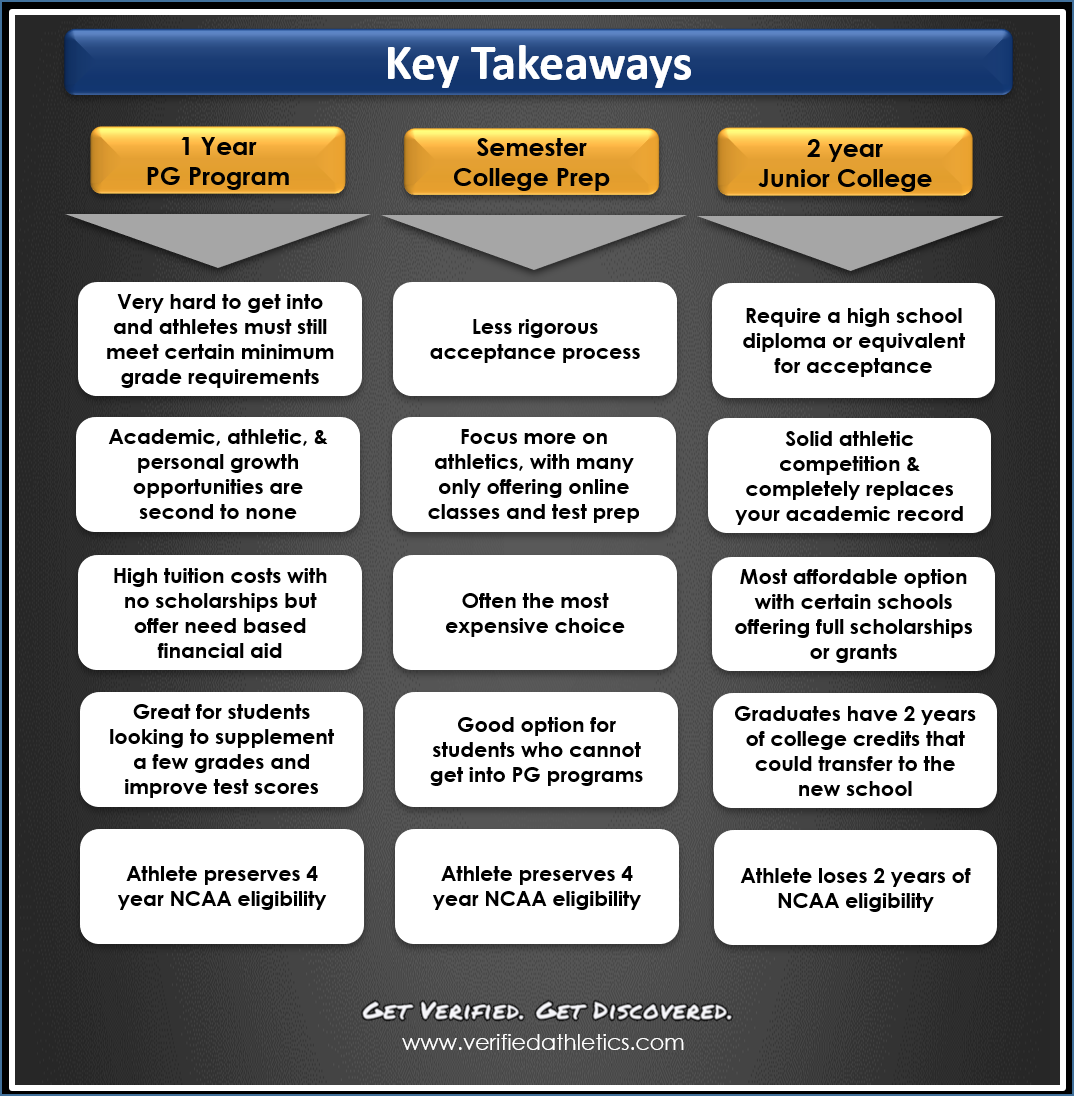
See the table below for the key takeaways for each option: